
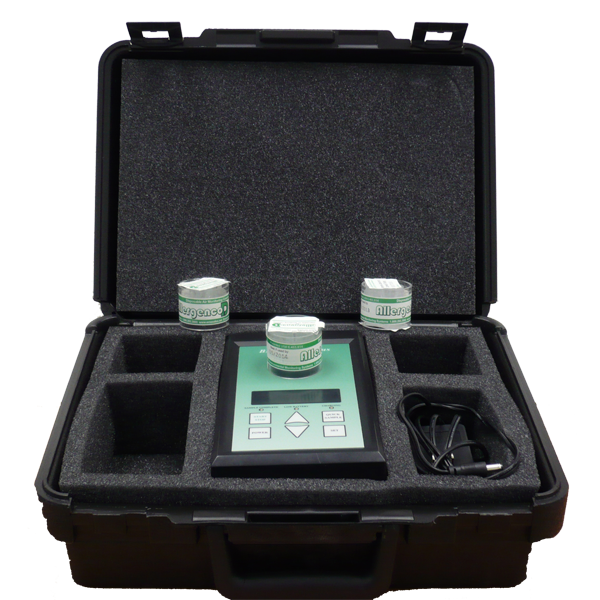
Description
Use a DIY Air Quality Mould Test Kit to Collect Professional Air Samples Yourself — Without Starting With an On-Site Inspection
Mould growth is not always visible. When there has been water damage,
persistent moisture, a musty odour, or concern about possible concealed
mould growth, air sampling can provide useful information about airborne
mould spores present at the locations and times sampled.
The Rental DIY Air Quality Mould Test Kit lets you collect
professional-quality air samples yourself and have them analyzed by an
ISO/IEC 17025-accredited Canadian microbiology laboratory.
We provide the professional air-sampling pump, laboratory-prepared
spore-trap cassettes, and step-by-step instructions. You collect the samples
and return them to our laboratory for analysis.
Your laboratory report identifies and quantifies major airborne mould spore
groups and allows indoor samples to be considered alongside an
outdoor reference sample.
- Professional air-sampling equipment supplied on rental
- Accredited laboratory analysis of your submitted samples
- Quantitative airborne spore concentrations reported as spores/m³
- Indoor-to-outdoor comparison to assist with interpretation
- Written PDF laboratory report
- Optional expert interpretation and consultation when additional support is needed
Professional sampling equipment. Accredited laboratory analysis.
DIY convenience.
Who Is This DIY Mould Air Test Kit For?
The kit is intended for people who want credible laboratory information
about airborne mould spores without necessarily beginning with a complete
on-site mould investigation.
- Homeowners and tenants investigating musty odours,
moisture problems, previous leaks, or other indoor air quality concerns - Landlords and property managers responding to tenant
concerns or documenting building conditions - Homebuyers and real estate professionals seeking
additional laboratory information as part of property due diligence - Small-business and office operators investigating
specific indoor areas or previous moisture problems - Remediation and environmental professionals who require
independent laboratory analysis of collected air samples
When Might Mould Air Sampling Be Useful?
Air sampling may provide useful information when you are investigating:
- A persistent musty or damp odour
- Previous flooding or water damage
- A roof, plumbing, foundation, or other building leak
- Persistent indoor moisture or dampness
- Concern about possible concealed mould growth
- A basement or other moisture-prone area
- An indoor air quality complaint
- A rental-property concern
- A home purchase, sale, or property-management decision
- A need for laboratory data as part of a broader post-remediation
assessment - A need for documented laboratory information before deciding whether
further investigation is warranted
Air-sampling results are most informative when considered together with
moisture conditions, visible observations, building history, sampling
locations, HVAC operation, and outdoor conditions.
What Comes in Your Rental DIY Air Quality Mould Test Kit?
Your kit provides the equipment and sampling media required to collect
controlled-volume air samples for laboratory mould-spore analysis.
- Professional Air-Sampling Pump — Rental
The same type of active air-sampling approach used in professional
indoor environmental investigations. - Laboratory-Prepared Spore-Trap Cassettes
Sampling cassettes prepared for collection and subsequent microscopic
analysis. - Indoor Sampling Cassettes
The number supplied depends on the kit size you select. - One Outdoor Reference Sampling Cassette
Every kit includes an additional cassette for an outdoor reference
sample. - Step-by-Step Sampling Instructions
Clear procedures guide you through the sampling process. No previous
microbiology experience is required. - Equipment Return Instructions
Instructions are provided for returning the rental pump after sampling. - Laboratory Analysis
Submitted samples are examined for major airborne mould spore groups
and quantified. - PDF Laboratory Report
Your laboratory results are provided electronically after analysis.
How the Rental DIY Air Quality Mould Test Kit Works
-
Choose the Number of Indoor Areas You Want to Test
Select your kit according to the number of distinct indoor rooms
or areas you want to sample.Every kit includes one additional outdoor reference
sample. -
Receive Your Sampling Equipment
Your kit is shipped with the professional air-sampling pump,
laboratory-prepared cassettes, and sampling instructions. -
Collect Your Indoor Samples
Follow the supplied instructions to collect air samples from the
selected indoor locations.Sampling typically takes approximately
10 minutes per location. Follow the instructions
provided with your kit for the appropriate sampling procedure. -
Collect the Outdoor Reference Sample
The outdoor reference sample should be collected at approximately
the same time as the indoor samples so that the outdoor spore
profile can assist with interpretation of the indoor results. -
Return the Samples and Rental Pump
Return the collected sampling cassettes and rental equipment
according to the instructions supplied with your kit. -
Laboratory Analysis
Once your samples arrive at Mold & Bacteria Consulting
Laboratories, they are processed and examined for airborne mould
spores. -
Receive Your Laboratory Report
Results are typically available within
3–5 business days after the laboratory receives your samples.
Shipping time is additional.Rush analysis may be available on request.
Choose the Right Kit Size
Choose your kit based on the number of distinct indoor areas you want
to sample—not simply the size of the building.
Every kit includes one additional outdoor reference cassette.
For example, if you want to test three indoor areas, select the
4-cassette kit: three indoor samples plus one outdoor
reference sample.
| Indoor Areas You Want to Test | Total Kit Size | Sampling Plan |
|---|---|---|
| 1 indoor area | 2 Cassettes | 1 indoor + 1 outdoor reference |
| 2 indoor areas | 3 Cassettes | 2 indoor + 1 outdoor reference |
| 3 indoor areas | 4 Cassettes | 3 indoor + 1 outdoor reference |
| 4 indoor areas | 5 Cassettes | 4 indoor + 1 outdoor reference |
| 5 indoor areas | 6 Cassettes | 5 indoor + 1 outdoor reference |
| 6 indoor areas | 7 Cassettes | 6 indoor + 1 outdoor reference |
| 7 indoor areas | 8 Cassettes | 7 indoor + 1 outdoor reference |
| 8 indoor areas | 9 Cassettes | 8 indoor + 1 outdoor reference |
| 9 indoor areas | 10 Cassettes | 9 indoor + 1 outdoor reference |
How Should I Choose My Indoor Sampling Locations?
Consider distinct areas relevant to the reason you are testing. Depending
on your property and objectives, these might include:
- A room with a persistent musty odour
- An area affected by a previous leak or water damage
- A basement or other moisture-prone area
- A bedroom, living area, or office of particular concern
- Different floors or sections of a building
- An area near suspected concealed moisture or mould growth
There is no single number of samples that is appropriate for every
building. Sampling requirements depend on the purpose of the investigation,
building layout, moisture history, and locations of concern.
Not sure how many areas to test?
Contact us before ordering and we can help you select an appropriate kit.
What Will Your Laboratory Report Tell You?
Your report provides quantitative information about the air samples
collected at the locations you selected.
The laboratory report includes:
- Major mould spore groups detected
- Airborne spore concentrations expressed as spores per
cubic metre of air (spores/m³) - Results for each indoor sampling location
- Results for the outdoor reference sample
- Indoor-to-outdoor comparison to assist with evaluation
of the overall spore profile - Standard laboratory comments, where applicable
What Types of Mould Spores May Be Reported?
Depending on what is present in the collected sample, reported categories
may include:
- Aspergillus/Penicillium-like spores
- Cladosporium
- Alternaria
- Chaetomium
- Stachybotrys
- Ascospores
- Basidiospores
- Other identifiable fungal spore categories
Non-viable spore-trap analysis generally identifies spores according to
their microscopic characteristics. Some closely related moulds cannot be
reliably differentiated to genus or species using this method alone.
For example, Aspergillus and Penicillium spores are commonly reported
together as Aspergillus/Penicillium-like because they
cannot normally be distinguished reliably from one another by routine
spore-trap microscopy.
How Is This Different From a Cheap Petri-Dish Mould Test?
Many inexpensive consumer mould kits rely on an agar plate left open to
room air. Microorganisms must settle onto the plate, remain viable, and
grow under the incubation conditions used before they can be observed.
That is a very different sampling method from controlled-volume
spore-trap air sampling.
The MBL Rental DIY Air Quality Mould Test Kit uses a
professional air-sampling pump and spore-trap cassette
to collect particles from a measured volume of air.
The collected sample is then examined microscopically for major airborne
fungal spore groups. The spores do not have to grow in culture before
they can be counted.
| Feature | Typical Passive Petri-Dish Kit | MBL Rental Air Test Kit |
|---|---|---|
| Sampling method | Passive settling | Active air sampling |
| Measured volume of air | No | Yes |
| Requires organisms to grow | Yes | No |
| Quantitative airborne concentration | Generally no | Yes — spores/m³ |
| Major spore groups identified | Limited to organisms that grow | Based on microscopic examination |
| Outdoor reference sample | Often not included | Included in every sampling plan |
| Laboratory report | Varies | Yes |
| Accredited laboratory analysis | Not typically | Yes |
The important difference is not simply the test kit. It is the
sampling method and laboratory analysis behind it.
How Should Mould Air-Sampling Results Be Interpreted?
Mould spores occur naturally in outdoor air and can enter buildings through
doors, windows, ventilation systems, and normal occupant activity.
Detecting mould spores indoors therefore does not, by itself, demonstrate
that a building has an indoor mould-growth problem.
Meaningful interpretation considers the
overall indoor spore profile, including:
- Types of spores detected
- Airborne concentrations
- Relative composition of the samples
- Indoor-to-outdoor relationships
- Differences between indoor sampling locations
- Moisture conditions and water-damage history
- Visible observations
- Building layout and HVAC operation
- Sampling conditions and the purpose of the investigation
An indoor spore pattern may sometimes suggest that further investigation
for a possible indoor source is warranted. Air sampling alone, however,
does not locate concealed mould growth.
What This Test Can — and Cannot — Tell You
Air sampling provides information about airborne mould spores collected
at a specific location during a specific sampling period.
It can be useful for comparing indoor locations with an outdoor reference
and for identifying spore patterns that may warrant additional
investigation.
The Test Can Provide:
- Quantitative information about airborne mould spores collected in each
sample - Identification of major mould spore groups based on microscopic
characteristics - Comparison of indoor samples with an outdoor reference sample
- Laboratory data that can help support decisions about whether further
investigation may be warranted
The Test Cannot, By Itself:
- Prove that an entire building is free of mould
- Locate every concealed source of mould growth
- Determine the cause of a moisture problem
- Establish a universally applicable “safe” or
“unsafe” airborne mould-spore concentration - Determine whether a particular health symptom was caused by mould
- Replace a complete building and moisture investigation when one is
warranted
Our objective is to provide useful laboratory information without
claiming more than the sampling method can scientifically demonstrate.
When Should You Consider a Professional On-Site Investigation?
A DIY air-sampling kit can be a useful first step, but a professional
building investigation may be more appropriate when:
- There is extensive visible mould growth
- Significant flooding or water damage has occurred
- The moisture source has not been identified or corrected
- Large or complex HVAC systems may be involved
- Concealed building cavities require investigation
- Previous remediation has not resolved the problem
- Formal inspection, documentation, or expert opinion is required for
legal, insurance, occupational, or other specialized purposes
In these situations, air-sampling data may still be useful, but it should
generally be considered as one component of a broader investigation.
What Clients Have Told Us
“We suspected a mould problem in our basement after a
long-standing moisture issue. The air-sampling results indicated an
unusual indoor Aspergillus/Penicillium-like spore profile, and the
information helped us decide where further investigation was
needed.”— Homeowner, Ontario
“The rental kit allowed us to collect air samples from a rental
property and obtain documented laboratory results. The instructions
were straightforward and the report gave us useful information for
discussing the next steps.”— Client, Ontario
Frequently Asked Questions
Do I need special training to use the kit?
No. The kit is designed so that non-specialists can collect the air
samples by following the supplied step-by-step instructions.
How long does it take to collect each sample?
Air sampling typically takes approximately 10 minutes per location.
Always follow the sampling instructions supplied with your kit.
How many samples do I need?
Choose your kit according to the number of distinct indoor areas you
want to sample. Every kit includes one additional outdoor reference
cassette.
For example, if you want to test three indoor areas, select four
cassettes: three indoor samples plus one outdoor reference sample.
The appropriate number of indoor samples depends on your sampling
objective, building layout, moisture history, and locations of concern.
Contact us if you would like help choosing a kit.
Why is an outdoor reference sample included?
Mould spores are naturally present outdoors, and outdoor concentrations
can vary with season, weather, vegetation, and location.
An outdoor sample collected at approximately the same time as the
indoor samples provides useful reference information when evaluating
the indoor spore profile.
Does detecting mould spores mean I have a mould problem?
Not necessarily. Mould spores normally occur outdoors and can enter
buildings from outside.
Interpretation should consider the types and concentrations detected,
the complete indoor spore profile, indoor-to-outdoor relationships,
moisture conditions, building history, and other relevant observations.
Can an air sample find hidden mould behind a wall?
Air sampling does not locate concealed mould growth.
In some circumstances, an unusual indoor spore profile may indicate
that further investigation for a possible indoor source is warranted.
Locating concealed mould generally requires an appropriate building
and moisture investigation.
Can the results tell me whether the mould level is safe?
There are no universally accepted health-based exposure limits for
airborne mould spores that allow a laboratory result to be classified
simply as “safe” or “unsafe.”
Results need to be interpreted in relation to the overall spore
profile, outdoor conditions, building history, moisture conditions,
and the purpose of the investigation.
Is this equivalent to hiring a professional mould inspector?
No. The kit uses professional air-sampling equipment, and the submitted
samples undergo laboratory analysis, but you select the sampling
locations and collect the samples yourself.
A professional on-site investigation may additionally include moisture
measurements, visual inspection, building-history review, HVAC
evaluation, concealed-area investigation, and professional selection
of sampling locations.
Can I use the kit after mould remediation?
Air sampling may be used as one component of a broader
post-remediation assessment.
Air results alone should not be used to declare an area
“mould-free” or to replace appropriate visual inspection,
moisture verification, and other post-remediation criteria.
How quickly will I receive my laboratory results?
Results are typically available within
3–5 business days after the laboratory receives your samples.
Shipping time is additional.
Rush analysis may be available on request.
Is return shipping included?
Return instructions for the rental pump are included with the kit.
Depending on your location and the shipping option selected, you may
use your own courier or request information about available prepaid
return options.
What should I do if the results suggest further investigation?
If the indoor spore profile or other available information suggests
that further investigation may be warranted, consider the laboratory
findings together with moisture conditions, visible observations, and
the history of the property.
Additional investigation by an appropriately qualified professional
may be appropriate. If you selected an interpretation or consultation
option, our microbiologist can also discuss the laboratory findings
with you.
Start With Objective Laboratory Information
If you are concerned about a musty odour, previous water damage,
persistent moisture, or possible indoor mould, you do not necessarily
have to begin with a complete on-site inspection.
Select the number of indoor areas you want to sample, collect the samples
using the supplied professional equipment, and have them analyzed by an
accredited Canadian microbiology laboratory.
Professional equipment. Accredited analysis. Quantitative results.
Optional expert support.
Need Help Before You Order?
If you are unsure whether the Rental DIY Air Quality Mould Test Kit is
appropriate for your situation or how many indoor locations you should
sample, contact us before ordering.
Mold & Bacteria Consulting Laboratories
1020 Brevik Pl., Unit 1A
Mississauga, Ontario L4W 4N7
Phone:
905-290-9101
Toll Free:
1-866-813-0648
Email:
info@moldbacteria.com
Reviews
There are no reviews yet.